Thursday, November 17, 2011

marine business practice

warranties and guarantees

 A warranty is like insurance for something new or a job done. In marine a warranty could be for new parts on a boat or engine   like belts, manifolds, pistons etc. the warranty of parts such as these (if there was one) would be that if the part was installed properly and used properly but broke due to manufacture failer or design the company that mad the part would need to replace the part or refund the money. Most warranties have a time limit like months or years , in this case it would be hours at sea.
quotations and estimates
quotations  and estimates are words to do with priceing. In this case these words are used when priceing jobs, parts or labour.  a quote is a definate price  given to the customer therefore if something isnt price uped or  something brakes during the job the customer dosnet have to pay as they had been quoted an amount of money. an estimate isnt a exacted price it is a around price to ensure that the customer pays for all work and parts. an estimate gives the customer a price range wich is the best type of priceing because it dosent cost the componey for other unkown damages and dosent upset the customer when problems that they werent awhere of occur.

charge out rates
charge out rates are an important part  of runing a business as charging to much will cause small amout of customers to come to your shop and charging to little will cause the business to be short of money. pricing of jobs in a new business can be judged  of other businesses  to ensure that jobs arnt over or under priced. charging out jobs can consist of parts, labour, cleaning, gst and sevrall others dependig on what kind of job is being done. parts and labour are a basic chagre out for jobs.

Wednesday, October 26, 2011

26 of october reflection

today we learnt about estimates and quotes and what they involve.
we learnt that giving a quote means a solid answer and that the customer only has to pay that even if other problems or cost occur. therefore giving an estamite is better as u can give a price range and a not a set deal. giving an estimate is the best kind of pricing on  a deal as  if a problem or extra damge occurs during the repair the customer can be notified and they can pay extra for that repair.

26 october , class reflection

quotations and estimates
avarage automotive hourly rate
$70-$130

making an estimate or quote:
identify what it needs
parts
materials
outwork
miscelanious( cleaning matterials , spare bolts , small amount)
oil, anti frezze
labour

marine gearboxes

explain the diffrent types of gear selection types found in

outboard gearcases and sterndrive:
the gear selector system in a gear case is quite simple only having a forward and revers.  forward and revers are selected by  a dog clutch. this clutch has three big teath on either side and are used to grab hold of either the forward or revers gear.the dog clutch is located inbetween the two gears. the dog cluth has movement as it is needed to lock in one gear. in order to lock in the gear the shift rod needs to be minoverd ( pulled up or pusshed down). doing this shifts the dog cluth on its slide locking its teath into the teath on the inside of a drive gear.  this is also the same in a stren drive but in a bigger scale and slightly more heavy dutey equipment. forward and revers can either be selected from the controll pannel in the boat or on the out board depending on the size of the engin or design of the boat.

inboard marine gear selectors:
gears are selected either by hydrolic or cable systems wich can be controlled from the main controll pannel. the reason why an inboard has this system compared to an outboard is because the engin is under the floor and would cause problems having to go down to the engin and back to change the gear, also inboard gearboxes are alot more heavy duty and there for need more pull to change. instead of a dogcluth system like a outboard it has a cluth pack wich is sevral clutch plates and spacers.when a inboard gear box is shifted it locks a sertan shaft or gear wich makes outside gears or plantintry gears rotate a spacifictway selected by the oporater.

what type of gears are used in outboards and strenlegs? give an explanation of why manafactures choose this types of gear.
there are two types of gears in a gearcase and stern leg, those gears are a pinion gear and two drive gears, theres only a forward revers and neutral because having more than one forward means that more moving parts need to be made, housed and mounted so they work smothly. doing this  would make the gear case harder to service. also there would have to be a type of clutch installed and a bigger gear case would need to be made bigger wich would cause more drag in the water making fuel econimany alot worse .

duo prop
 a duo prop is basicly two props on the same drive shaft on one  gear case. the shaft that holds the two propellers is designed so one prop spins the opposite direction to the other propellor. the reason for the props spinning opposite directions is to remove  thrst and disturbistance in the water. the propellor shaft that the two props run off is made so one end is fixed an one  rotates the opposite direction on bearings.

jet unit vs surface drive unit:
a jet unit drive system is used by drawing water in and pushing it out at a high pressure through a smaller hole it came through. jet units re used quit alot on small race boats wich are not on wavey surfaces. a surface drive unit is designed so two out of three blades on the prop are under water and the other out above the water. having a surface drive can work to some advantages on diffrent types of boats. boath these types ofdrive systems dont realy work well on wavey or ruff surfaces as if the boat leaves the water just slightly all power and drive stops as there is no water to be driven off. there for these types of drives  are used on heavy boats or for boats on  flat water for full power. i would chosse a jet unit over  surface drive because how simple the system is and  how much power can be created.

Saturday, October 1, 2011

gear boxes

 in class we pulled apart and inspected a toyota 4 speed gearbox. the gear box was for a rear wheel drive (north south) engin. the gear case  was in ok condition and had small wear and chips. bolts and threads were in ok condition.
inside the gear box there was a input and out put shaft ,revers idler and driver shaft.
on the driver shaft there were 5 gears that were all part of the shaft  and alwasy spin at the same speed as each other.there were 4 helical cut gears that were  1,2,3 and forth gear. the fith gear was a straigh cut gear and was revers gear . these gears were all in good conditon and so wear the roller bearings inside on the shaft.

out put shaft
the output shaft held the all the gears except forth wich is on the input shaft. the out put shaft also holds two sychro units wich are used to select the gears when changing gears.  these gears were all in good condition ,well lubricated, bearings were good and not lumpy or worn. when i put the gears back together i checked the play and clearinces to see if a spacer or washer  is needed to close the clearinceto reduces play wich can cause extensive wear.

HELLICAL
a hellical cut gear  is a long cut gear wich is alot stronger than a straight cut gear. the hellical cut gear is used manly in forward drive gears (not revers). altough some older gear boxes had first  and sometimes sceond gear with a straight cut gear. this has changed as manifactures have wated to improve durablitiy and overall strength of of the gear boxes.


STRAIGHT CUT
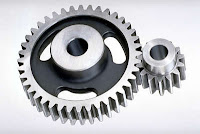
a straight cut gear is a straight tothed gear wich is mostly used in the revers system (driver ,driven and idler) . the problem with straight cut gears is that the weight of the drive is pressed on a small straight surface wich isnt as strong as a long offset cut like a hellical cut. the most common issue with staright cut gears is knocking  a tooth off or shreading teath wich creats excessive noise slippage and further damage.


SYNCRO UNITS
a syncro unit is a system that helps with the selction of gears. inside a sysncro unit is a straight cut gear wich slots into a houseing. two circlips are inserted with 3 small metal spacers locking the spacers in. having these small metal bars alowws the gear housing to slide backwards and forwards selcting the gear needed.the gear inside the houseing slots into teath on the output shaft  wich makes it fixed to the out put shaft.having a faulty syncro unit or a a syncro unti assembeled wrong can make cahnging gears extremly hard if not impossible.

SELECTOR SHAFTS AND SYSTEM
changing gear involves a few diffrent mechanisims. the gear leaver ataches to a selector shaft wich hooks on to sevral other selector shafts wich are attached to the syncros and revers system. on the toyota gear box i did there were 3 selector shafts. there were also 3 tic tacs wich slotted between the selector shafts to prevent selecting to gears at once.

 BEARINGS
the bearings inside the toyota gear box were mostly roller bearings some caged and some like the input shaft into the output shaft were free roller berings (without cage). also there were oil groves were the gears sloted onto on the out put shaft wich act like beaarings as the pump oil in and around the gear to lubricate it. on the gear box i did some bearings needed to be replaced as some rollers were missing and some were lumpy  and worn. the out put shaft ran on a caged roller bearing wich was ok and not lumpy. when re assemberling i lubricated all the bearings to ensure  as little wear as possible.

Thursday, September 22, 2011

things we checked in class

In class  we messured most of the engin parts to check for wear or damage. we checked these messurements with the manifactures specs to see if the part was reusable or had to be replaced.

CAMS
i messured the lobes of the cam and barto see if it was bent or worn. i checked this with a dti gauge
also on the cam we checked the oil clearnce with plasit gauge

journals were visualy inspected for scartches clogs in oil groves so that oil can flow through easy for lubrication.

VALVES
we messure the tickness and lip size of the vlaves to see if it has to much play in the vlave seals and if the valve sits on its seat properly. i messerd this with a micromiter

VLAVE SPRINGS
 i messured the compression of the valve springs  with a valve spring tester. i also checked the springs against a square to see if they were slightly bent and needed to be replaced. a few springs needed to be replaced as they  were not square at all.

PISTON
i messured the oil clearences between the piston rings to see if they were worn and need replacing.also messured the  diamiter of the  piston to see if it had enogh clearince in the boar.

i made sure the con rod was straight and  not bent, worn  or damaged. having a bent or danaged con rod can cause alot of internal problems and make the piston wear against the boar and possibly bend the crank.

CRANK SHAFT
i messured the the journals on the crank to check for ovality  and taper to see if there was enogh oil flow and lubrication to the engin parts. i also checked the oil clearnce with plasti gage to check oil clearnce through the crank

Sunday, September 18, 2011

4 stroke block

the block houses the pistons con rods and crank. the block is wear the combustion happens there for the block is  very strong and usauly made of cast steel. inside the block are boars wich house the piston

PISTONS
 the piston slides up and down the boar buy the rotation of the crank. the rotation of the crank starts of either by a starter moter or a bump start. the piston draws air and fuel into the boar, compresses it, the park plug ignites the air and fuel pushing the piston down creating a rotating motion in the crank to help pump the other pistons up and down. with out the piston it would be impossable to create compression or power. on a 2 stroke some pistons are curved to circulate the air and fuel around the boar instaed of straight out the exhaust. on a 4 stroke standerd pistons have flat tops or small indents so the piston dosnt hit the valve. on performance engins when high revs or a higher octane fuel is used a forged piston can be uesd for exxtra strength so no holes or damge can be don to the piston head. the piston has sevral groves on the side for oil rings. these oil rings help lubricate the boar and piston as it pumps up and down and also stops oil from getting on top of the piston to wear combustion takes place. worn or broken rings creat alot of smoke as oil is being burned with the air and fuel.


GUGEN PIN
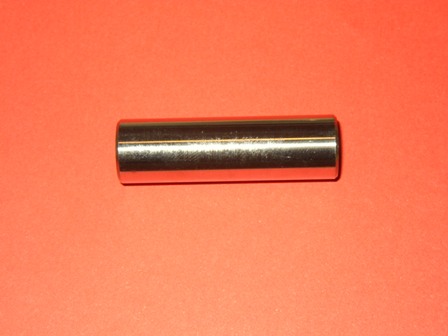
the gugen pin holds the piston to the con rod.  it act like a bearing with help of the oil for lubrication so that the piston can stay straight in the boar and the con rod can rotate with the crank. it is important that the gugen pin is strong as a weak gugen pin can cause alot of damage if it brakes.on a 2 stroke the gugen pin runs on roller bearings as the lubrication is air, fuel and oil. on a 4 stroke it ues oil to lubricate and rotate. with out oil the parts can heat up and melt togeather or sease reacking the engin.


CON ROD
the con rod or connecting rod coneect the gudgen pin and piston to the crank.  the con road connects to the crank by main journals. instead or caged roller bearings in these journals like on a 2 stroke there are oil groves and sleeves wich relei on the oil to lubricate these moving parts. when inspecing the con rods its best to check that they are straight non damged like buring or chipping and havnt been case hardend as this can effect the overall strength.


CRANK
the crank is a vital part of the engin as it truns  up and down movement into rotaing movement wich is transferd onto the fly wheel. the crank is held to the bottme of the block by main journals. these main journals have the same lubricating  system as the journals that hold the con rod to the crank.  the crank holds the kenitic energy  of the piston and  helps pump the other pistons around.  when inspecting the crank i checked the size of journals. if it was bent with a dti gaguge.  the crank was fine with the manifaciures spces.